A colleague at work suggested we visit the Kgalagadi Transfontier Park, but warned that we needed sufficient time to do it justice. It is a 13-hour drive from Joburg, so it is the kind of place where you need more than a weekend in order to experience it properly. I started looking at accommodation options in August 2014, and quickly realized that what few options were available in the park book up very quickly. We managed to piece together a few options that would allow us a week to explore the park. Part of my plan was to stay in the wilderness camps- they are small with only a few huts per camp, and they are unfenced, so you are completely immersed in the surroundings. Also, there is a gorgeous community-run lodge in the Kgalagadi that I wanted to stay at, !Xaus. We spent a combined total of seven nights in the park: four at !Xaus lodge, two at two different wilderness camps (Kalahari Tented Camp and Kieliekrankie), and one at the rest camp just inside the park gates (Twee Rivieren).
The animals in the Kgalagadi need to be hearty and able to survive long periods of time without water, so the park hosts a bit of a different mix of animals than what we've seen in other game parks. Instead of impala we saw springbok, and instead of kudu we saw oryx. We did have several big cat sightings, but typically they were quite shy and kept their distance. We saw a cheetah tail fleetingly as she disappeared over a ridge, we glimpsed another cheetah perched high on the rocks before she tucked herself back into hiding, and we waited, unsuccessfully, for the cheetah and cubs that were reportedly "just over there" to come out of hiding. We did manage to see a black-maned lion mating, tons of black-backed jackals, and we had an incredible after-dark sighting of a rare brown hyena.
Covering nearly 40,000 square kilometres, this transfontier park is huge (random fact: it's one of Africa's largest protected wilderness areas). We were able to cover the lower/west section of the park, from the South Africa's Tween Rivieren gate to Namibia's Mata-Mata gate. While a 4x4 is not necessarily required to get around the main roads of the park, our Getz might tell a different story after spending a week bouncing along on the badly corrugated roads.
This isn't the place to go if you're looking for quick gratification and modern conveniences. It is the place to go though if you're looking to press the pause button on everything for a little while. There are no tour buses or wifi, just barren landscapes, massive skies, and quiet nothingness.
The long road from Upington to the entrance of the Kgalagadi.
Our first night in the park we did a game drive with SANParks. We saw more black-backed jackals than we could count, and had an incredible sighting of a brown hyena. Yours truly spotted the hyena after the sun went down with the help of a spotlight. Unfortunately I was too focused on my duties as spotlight holder to take a photo.
Herd of Oryx.
Looking out over the nothingness.
This is a rare nocturnal tree mouse. You know there is a absence of high-profile sightings when people are telling you about a tree mouse.
Napping during the day...
...And getting busy at dusk. When we first witnessed this in
Kenya, we thought it was a once-in-a-lifetime kind of sighting...apparently not.
Having a rest. Note the black mane on the male. This is the best shot I could get of these rare creatures.
After a long and dusty drive that attempted to claim the bottom of our car, we thought it warranted a celebration with a bit of bubbly.
Our desert tent at the Kalahari Tented Camp.
Roasting marshmallows. This happened after a jackal came for a visit to the very same braai...M threw rocks and said "GO JACKAL, GO!" Aside from being mildly terrifying, it was hilarious.
Good morning!
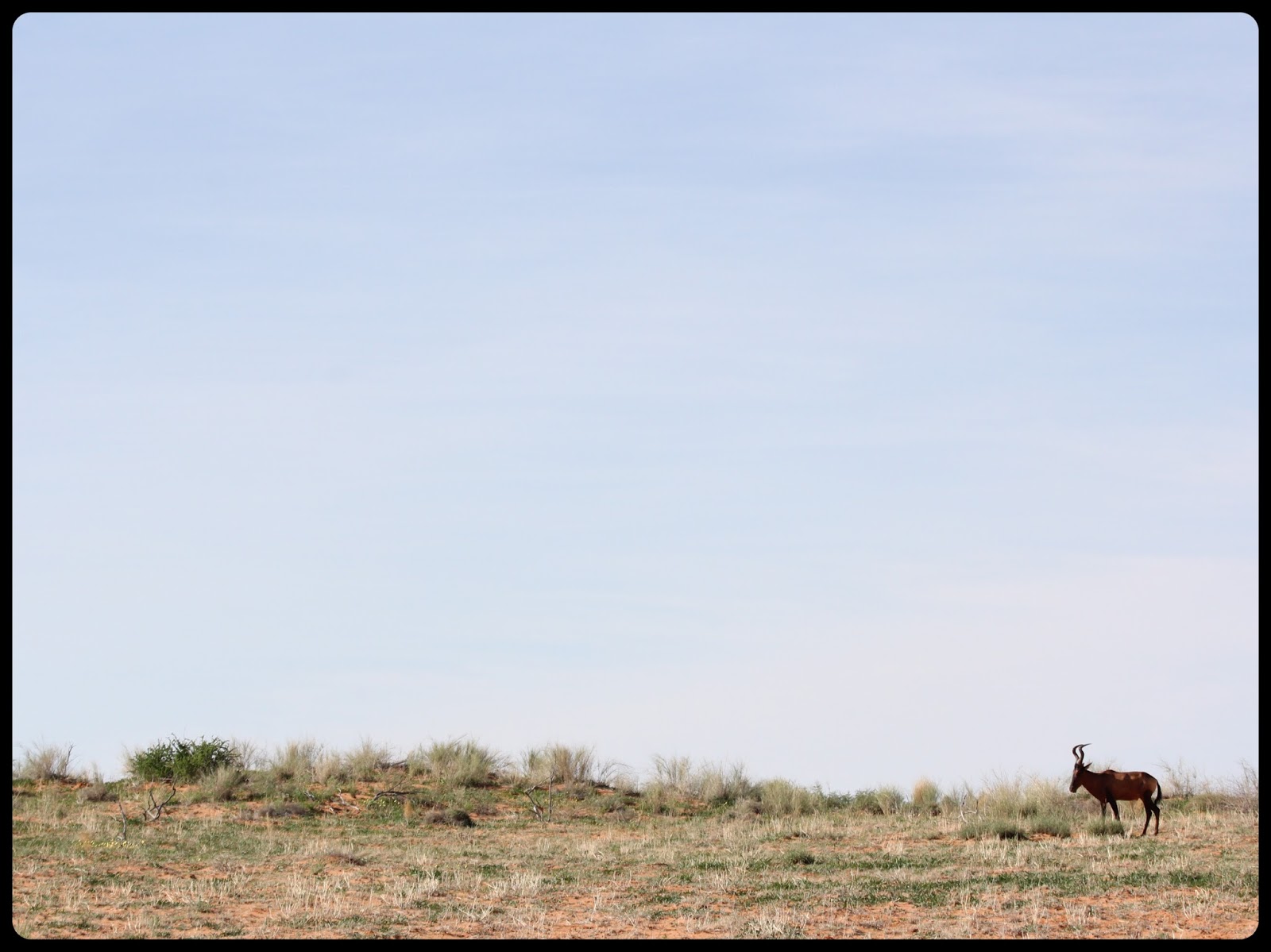
Red Hartebeest.
Are they kissing, or both trying to suck water out of the sand?
Cheetah just sitting under a tree, checking out the surroundings.
Getting ready to lay down for a little cat-nap.
Verreaux's Eagle Owl. We saw quite a few of these guys (and many other birds of prey that I have no idea what they were) in the Kgalagadi. We even saw two of these owls together having a rest in a tree. I didn't know owls made friends.
Giraffes on the move.
Giraffe body-guard standing watch while his buddy has a drink. All of the watering holes in the Kgalagadi are man-made. In this arid landscape there would otherwise be no water, and the animals would be forced to leave the protected area of the park in search of water.
What you see is the 4x4 road into !Xaus, and a whole lotta sour grass. M discovered he's highly allergic to this special substance. Lucky for us, one of the other guests at the lodge just so happened to be a doctor. An allergy doctor. Thank you, universe.
We were in the porcupine room.
Red sands of the Kgalagadi.
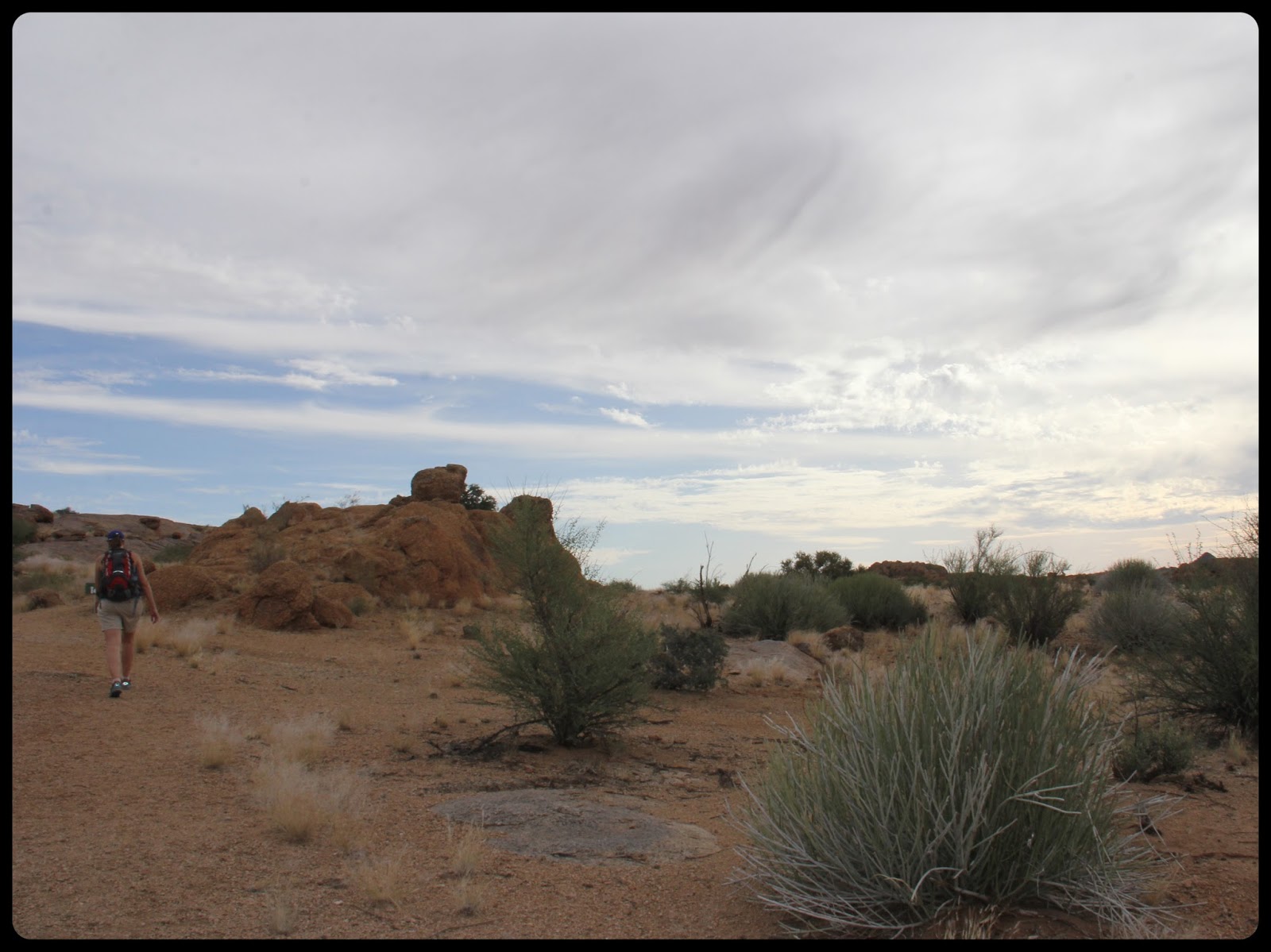
Morning bush walk. We learned about the trees and the smaller birds and insects of the area.
Team blue-hat.
Looking up at the lodge from the salt pan.
Visiting the Khomani San (Bushmen) of !Xaus.
Handicrafts made by the Khomani San.
Love the juxtaposition of this photo: tourist and "local" bushman, with the "tips" sign between them.
View across the salt pan (if you look very closely you can see the !Xaus lodges built into the ridge above the salt pan).
Evening drive through the dunes to see the other salt pans in the area.
Sundowners.
Contemplating life.
Happy in the dunes. Photo credit: our new German friends.
Meerkats!
African skies.
Red Hartebeest on the plains.
A full day game drive resulted in this sighting. A tortoise.
Springbok on the run.
Our hut at Kieliekrankie. The front had floor-to-ceiling windows that looked out at a watering hole (pictured below), and I got up several times in the night to check if anyone was paying the spot a visit. There was even a log book in our room to record sightings. Apparently there is a leopard in the area that favours this spot, but I never saw her.
Two black-backed jackals coming for a drink at the watering hole. Similar to the giraffes, one kept watch while the other took a drink.
Desert life.
Braai on the deck at Kieliekrankie.
Goodnight, Kgalagadi.